Open almost any weak literature review and you will see the same thing. A polite parade of summaries. Smith found this. Jones found that. Lee found something else. Ten paragraphs later you still do not know what the field actually understands, or why the author's own study needs to exist.
A good review is not a list of what other people said. It is an argument about what we know and where that knowledge runs out. This guide shows how to build one step by step, whether it is a thesis chapter or the background section of a paper.
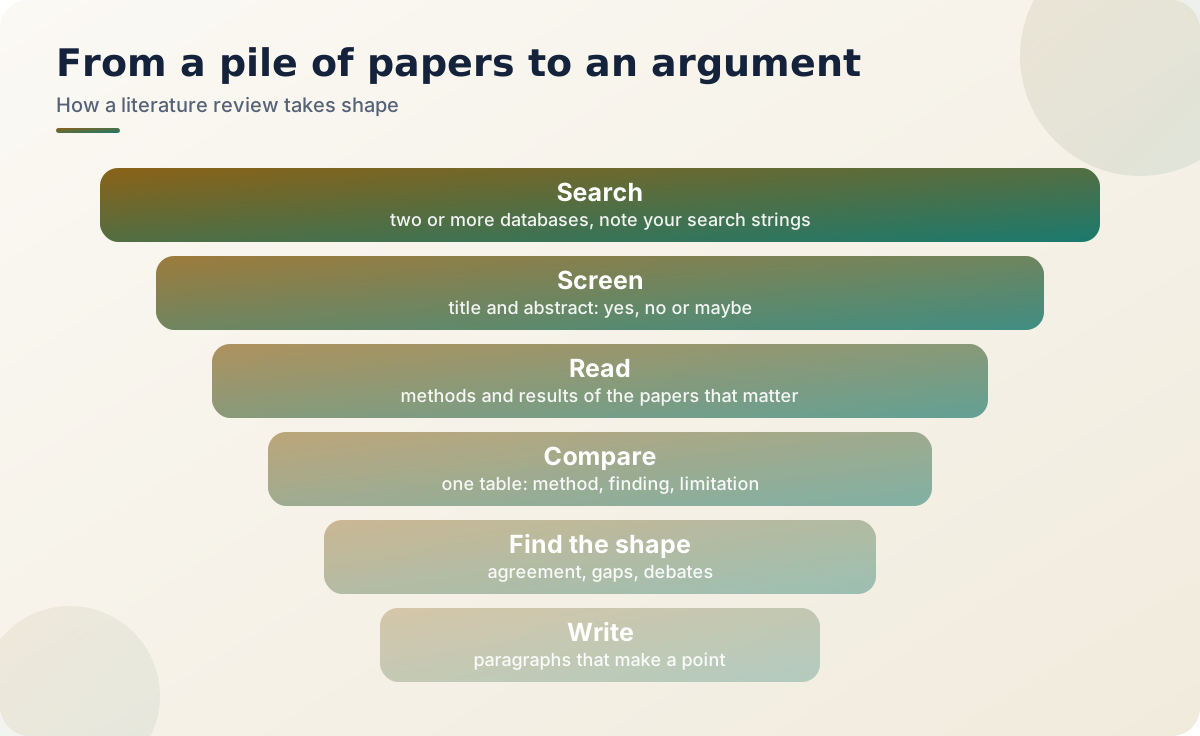
Part 1: Begin with a question, not a topic
"Climate change and agriculture" is a topic. It will hand you four thousand papers and a headache. "How do low-carbon farming practices change rice yields in South Asia?" is a question, and a question tells you what to include and, just as usefully, what to leave out.
Put it at the top of your notes and test every paper against it. If a paper does not help answer the question, it goes into a "maybe later" folder, however interesting it is.
Part 2: Search properly, and write down how
- Use at least two sources. Combine a general one like Google Scholar with a proper database such as Scopus or Web of Science, plus a subject database if your field has one.
- Try synonyms. "Wetland", "marsh" and "floodplain" can all describe the thing you care about, and a paper using the other word is invisible to you otherwise.
- Keep a short log. Note the date, the search string and the number of results. When a reviewer asks how you found your sources, you will have an answer.
- Follow citations both ways. Look at what an important paper cites and at who has cited it since. Some of the best finds turn up like this.
- Do not ignore grey literature when the topic is policy-driven. Government reports and agency datasets often hold what journals do not.
Part 3: Read in layers
Nobody reads three hundred papers in full. Go through them in passes.
- Title and abstract. Decide yes, no or maybe for each paper.
- Introduction and conclusion. Find the claim and judge how strong the evidence looks.
- Methods and results. Only for the papers that survive. These get a proper read.
While you do this, keep one table with a row per paper.
| Column | What to record |
|---|---|
| Citation | Author, year, journal |
| Setting | Country, group or context |
| Method | Survey, field data, model, review and so on |
| Sample | Size and how it was chosen |
| Main finding | One sentence |
| Limitation | What the study cannot tell you |
| Link to your question | One line |
When you finally sit down to write, you are really writing from this table.
Part 4: Find the shape of the literature
This is the step people skip, and it is what separates a review from a list. Before you write a word, read your table sideways and ask:
- Which findings agree, and which clash?
- Which methods dominate? Is every study a survey while nobody has tried field data?
- Which places or groups are over-studied, and which are missing?
- Has the conversation shifted over time? An old consensus that newer work is starting to challenge is a story worth telling.
Organise the review around what you find: by theme, by method, or by debate. Almost never by individual author. The patterns are your structure.
Part 5: Write paragraphs that make a point
A paragraph that works usually starts with a claim in your own words, brings two or three studies to support it, and compares them rather than listing them. Then it admits a complication, maybe a study that disagrees or a limit in the evidence, and hands over to the next idea.
The difference is easy to see. A weak version: "Rahman (2018) studied river pollution in Dhaka. Karim (2020) studied pollution in Chattogram." A better one: "Studies of industrial pollution in Bangladesh cluster around Dhaka (Rahman, 2018), with far less attention to other industrial regions such as Chattogram (Karim, 2020). That matters because discharge patterns differ with the kind of industry." The second version has a point. It tells the reader where the gap is.
Part 6: End by pointing at your own work
The closing section should do three things. Sum up the main patterns in a few sentences, name the clearest gap, and say how your study fits into it. If you reach the end and cannot find a gap, either the literature is more complete than you thought or you have not looked hard enough at your table.
Before you hand it in
- Does every paragraph make a point and not just report a paper?
- Are older landmark studies and the newest ones both included?
- Did you cite at least some work that disagrees with your own view?
- Could a stranger tell from your methods how you found the sources?
- Does the reference list match the text in one consistent style?
- Has someone outside your field read it and followed the argument?
Frequently asked questions
How many papers should a literature review include?
There is no fixed number. It depends on the field and the question. A narrow question with a clear boundary gives a manageable set, and quality of synthesis matters more than count.
What is the difference between a narrative and a systematic review?
A narrative review builds an argument from selected sources. A systematic review follows a strict, documented protocol for searching, screening and reporting, for example using the PRISMA guideline.
Can I include preprints?
You can, but label them clearly, because they have not been through peer review, and check whether a published version exists.
How do I avoid plagiarism when summarising?
Write from your own table and notes, paraphrase in your own words, and cite every source. A reference manager helps you keep track.
Related reading
- How to spot a predatory journal before it costs you: which sources and journals to trust
- প্রথম গবেষণা প্রবন্ধ লিখবেন কীভাবে: turning your review into a full paper, in Bangla
- From law to research: choosing the right Scopus journal: where to send the finished work
- Writing a systematic review: scope, screening and reporting: when your review has to follow a strict protocol
Tools organise things. They do not decide what matters, and that part is still yours.