If you have ever published a paper, or even just put your email on a university page, you already know the feeling. A message arrives that starts with "Dear Distinguished Professor" and offers to publish your work in seven days. The journal name sounds almost right. It might even be one letter away from a real one.
Most early-career researchers get these. Some answer them. A few get burned, and the damage is more than the fee. A paper in a bad journal can sit on your record for years, and it can be very hard to take back.
So how do you tell the difference? Not with a single test. You look at several small things and see whether they point the same way.
Part 1: Start with how they found you
Real journals do sometimes invite papers, but they usually do it with care. They mention your actual work, they name an editor you can look up, and they do not put a deadline on it. The suspicious ones send the same flattering email to thousands of people, and the subject line promises something no honest journal can promise, like guaranteed acceptance or review in a few days.
One email is not proof of anything. But if the email is also vague about the journal's topic ("all fields of science and engineering"), take a breath before you reply.
Part 2: Check the indexing claim yourself
This is where a lot of fake journals get caught. They put logos on their website, or claim to be "indexed in Scopus" or to "have an impact factor", and hope nobody checks.
- Search the title in the Scopus source list or the Web of Science master journal list.
- If the journal says it is open access, look it up in the Directory of Open Access Journals.
- If you cannot find it where it says it should be, assume the claim is false until proven otherwise.
- Be careful with impact factors. Some companies sell something that looks like an impact factor but is not the real thing.
Part 3: Look at the people behind it
Open the editorial board page and pick two or three names. Look them up independently, not through a link on the journal's site. Do they work where the page says they do, and do they know they are on the board? It sounds strange, but some journals list scholars who never agreed to join.
Then look at the publisher. Is there a real address and a real way to contact someone? Is the publisher a member of an organisation like COPE, which sets ethical standards? An editor-in-chief who uses a free mail address is another warning sign.
Part 4: Read a few articles
This is the check people skip, and it tells you more than the website does. Open three or four recent papers.
- Are they carefully written?
- Do the references look real?
- Is there any sign of actual peer review, such as received and accepted dates that are weeks apart rather than days?
- Do the topics fit together, or is it a strange mix that no real editor would put in one journal?
If the papers look like something you would be embarrassed to cite, do not publish there.
Part 5: Money, and how it is explained
Many good journals charge fees. Open access journals often have article processing charges, and there is nothing wrong with that on its own. What matters is how honest they are about it.
| Honest journal | Warning sign |
|---|---|
| States the fee clearly before you submit | Shows the fee only after your paper is "accepted" |
| Explains waivers and what the fee covers | Asks you to pay urgently |
| Takes payment through an official channel | Asks for money into a personal account |
Ask yourself: do I know exactly what I would pay, and what I would get for it?
Part 6: Peer review that is not
Real peer review takes time. Several weeks is normal, and a few months is not unusual. When someone promises a decision in forty-eight hours, they are probably not reviewing anything. If you submitted somewhere and acceptance arrived the same day with no reviewer comments at all, that tells you something too.
A short routine before you submit anywhere
- Search the exact journal name plus the word "predatory" or "complaint", and see what researchers say.
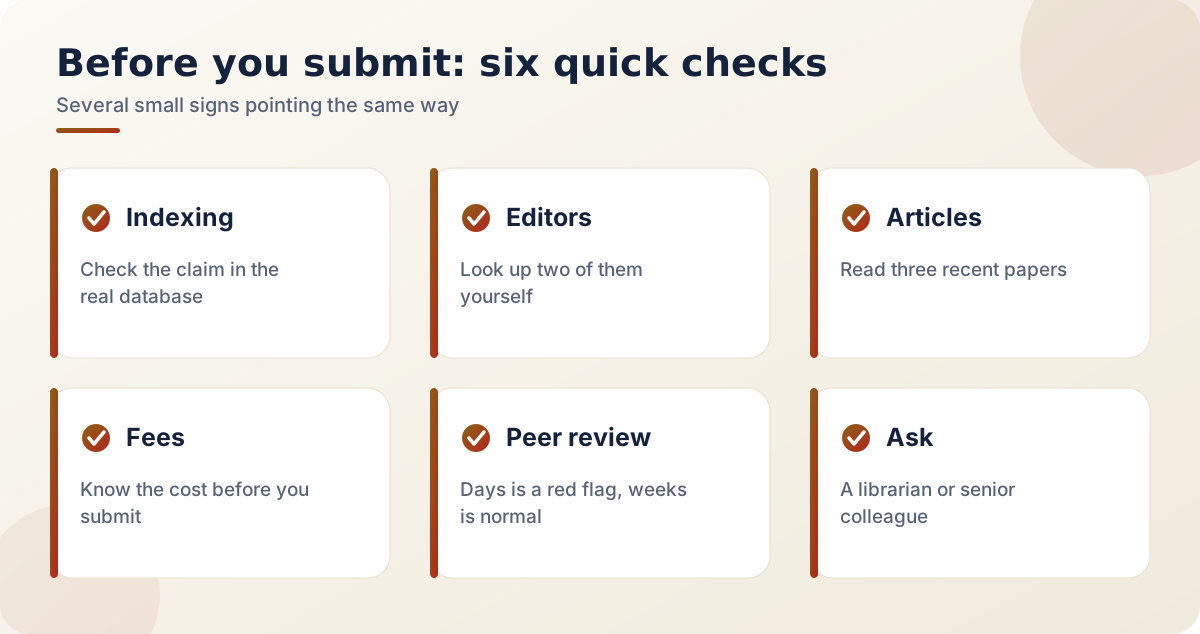
- Check the indexing claim in the actual database.
- Look up two editors yourself.
- Read three articles.
- Find the fee and the review process in writing.
- Ask a senior colleague or your librarian. Librarians know this and are usually delighted to be asked.
The initiative Think. Check. Submit. offers a good public checklist if you want one to follow.
Frequently asked questions
What if I already published in a predatory journal?
It happens, and it is not the end of your career. Withdraw the paper before it appears if the journal allows it, or ask for a retraction in writing. If it is already online, be open about it later and focus on publishing better work.
Is every new open access journal suspicious?
No. Many honest journals are new. Check editors, articles, policies and fees carefully, and do not judge by age alone.
Are expensive journals always better?
No. High fees do not prove quality, and low fees do not prove the opposite. Look at the whole picture.
Can I trust a journal because a famous university hosts it?
Not automatically. Check it in the same way as any other.
Related reading
- From law to research: choosing the right Scopus journal: choosing a journal once you have checked it
- How to write a literature review that is more than a list of summaries: building the background for your paper
- প্রথম গবেষণা প্রবন্ধ লিখবেন কীভাবে: writing the paper, in Bangla
A good journal does not need to chase you. The venues your supervisor trusts and your field actually cites are where you should look first. It is slower, but it is the version of the story where you are glad, five years later, that your name is on the work.