A systematic review is not a long literature review. It is a method: you decide in advance how you will search, what you will include, and how you will judge the evidence, and then you follow those rules even when the results are inconvenient. That discipline is what makes the conclusions trustworthy, and it is also what makes the work take months.
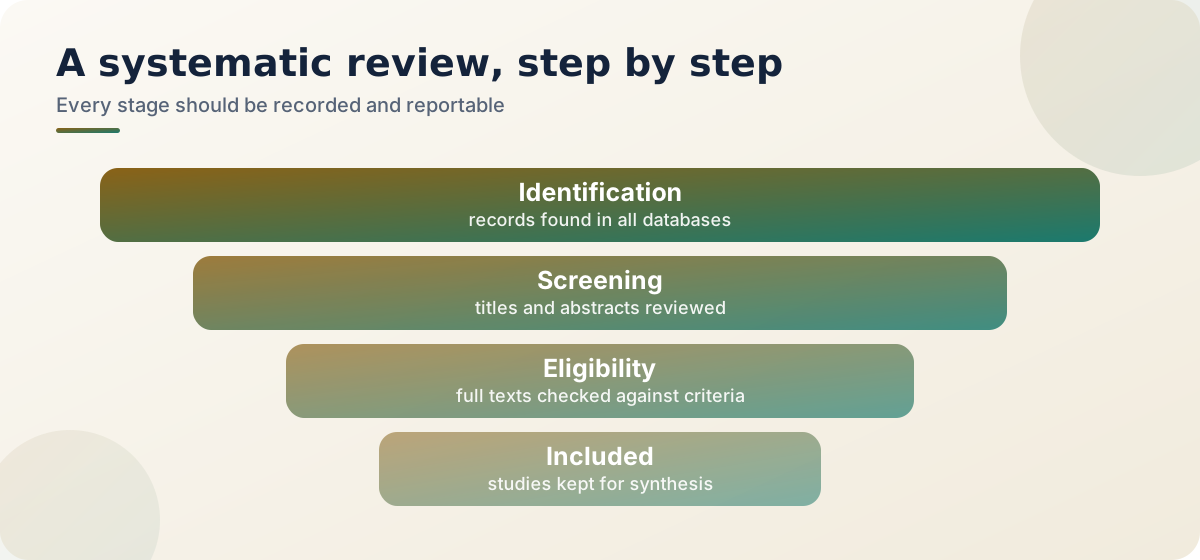
This guide walks through the stages in order: framing the question, writing a protocol, searching, screening, extracting data, judging quality, and reporting.
Part 1: Frame a question you can actually answer
A systematic review starts with a narrow, answerable question. A structure such as population, intervention or exposure, comparison and outcome (PICO, or a variant that suits qualitative or policy topics) keeps the scope tight. If you cannot state the question in one sentence, the search will drift.
Part 2: Write the protocol first
Decide inclusion and exclusion criteria, databases, date limits, languages and the screening method before you look at results. Writing this down in advance, and registering it where possible, protects the review from choices that are made to fit the findings. PROSPERO is a well-known register for many health-related reviews, and the Open Science Framework can host protocols for other fields.
- Eligibility: study design, population, setting, outcomes.
- Sources: which databases and which other routes, such as reference lists.
- Methods: how you will screen, extract data and judge quality.
Part 3: Search and keep records
- Choose several databases suited to your field, plus other routes such as reference lists.
- Build the search string from your question's key concepts and their synonyms.
- Save the exact string and the date of each search.
- Export all records into a reference manager, such as Zotero, and remove duplicates, keeping a count at each step.
Part 4: Screen in two passes
First screen titles and abstracts against your criteria, then read the full text of what remains. Record a reason for every full-text exclusion. Where more than one reviewer is involved, screen independently and agree rules for resolving conflicts.
Part 5: Extract data and judge quality
Use a structured extraction form, test it on a few studies, then apply it to all. Assess risk of bias with a tool that fits the study designs you included, and explain how that assessment shaped your conclusions rather than just listing scores.
| Stage | What to record |
|---|---|
| Identification | Databases, search strings, dates, number of records |
| Screening | Records after duplicates, number excluded at each pass |
| Eligibility | Full texts read, reasons for exclusion |
| Inclusion | Studies included in the synthesis |
Part 6: Report so that others can follow
Follow a reporting guideline such as PRISMA. Include the flow diagram, a table of included studies, the quality assessment and a clear statement of limitations. Say what you could not find, and avoid claiming more than the evidence supports.
Frequently asked questions
How is it different from a literature review?
A systematic review follows a pre-defined, reproducible method. A narrative literature review is more flexible. For the second, see our guide on writing a literature review that is more than a list of summaries.
Do I need two reviewers?
Two independent screeners is the usual standard. If you work alone, say so as a limitation.
Is a meta-analysis required?
No. If studies are too different to combine, a structured narrative synthesis is acceptable.
How long does it take?
Often many months, so plan for it.
Is PRISMA a method for doing the review?
No. PRISMA 2020 is a reporting guideline with a 27-item checklist and a flow diagram that show how to report a review. The method itself comes from your protocol.
Where can I register my protocol?
PROSPERO is the well-known register for many health-related reviews. For other fields, the Open Science Framework is a general alternative.
Official and outside resources:
Related reading
- How to write a literature review that is more than a list of summaries: the lighter, narrative cousin
- How to choose a Scopus journal: where to send the finished review
A good systematic review is honest about its own limits. Follow your protocol, record every step, and let the evidence say what it says.