Authors often begin with a list of high-ranked journals and then try to fit the paper to it. That is the slow route to rejection. A better question is simpler: which journals already publish this kind of work, for this kind of reader, and can I verify that they are what they say they are?
This guide is for researchers who want a Scopus-indexed journal and would like to choose one with a clear head. It covers how to start from the paper, how to check indexing yourself, what the metrics mean, and how to avoid paying for a bad decision.
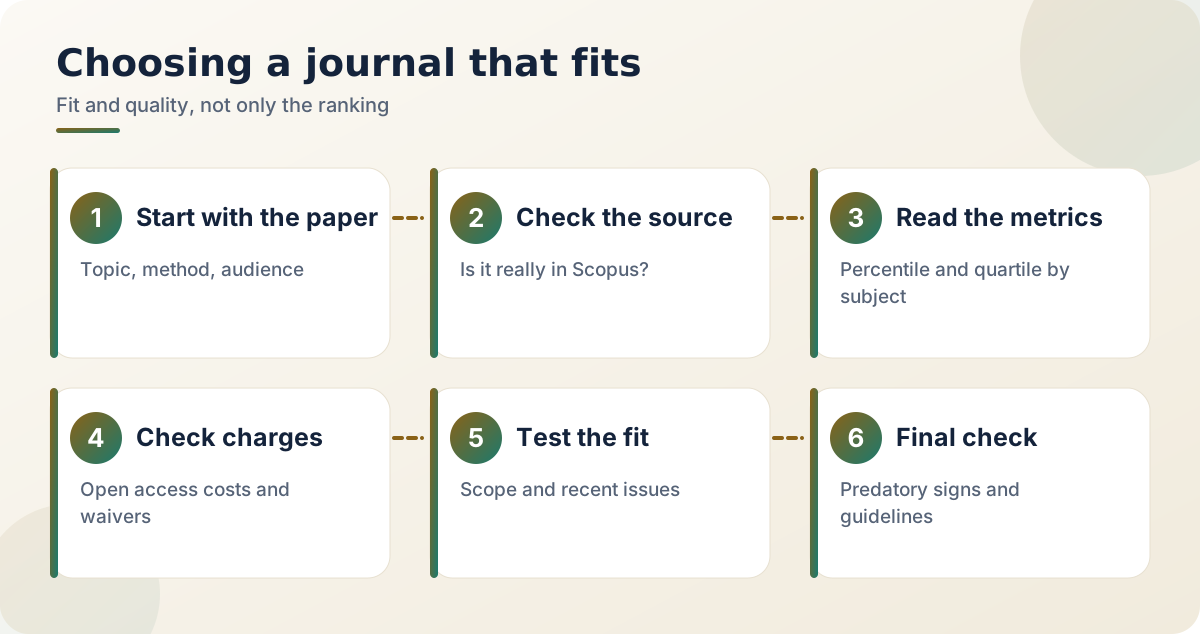
Part 1: Start from the paper, not the ranking
Write one sentence on what the paper contributes, then look for journals that already publish that kind of contribution, in that method, for that audience. Ask a supervisor or a colleague which journals they read and cite. The reference list of your own paper is also a good map: the journals you cite most often are natural candidates.
Part 2: Is the journal really in Scopus?
Check the journal's own record on the Scopus source list rather than relying on its website. Websites sometimes claim indexing that has lapsed or never existed.
- Source record: the journal's title in the current Scopus source list.
- Status: active, not discontinued.
- Publisher: a known publisher with a clear editorial board and contact.
Part 3: Percentile, quartile and what they mean
Scopus metrics such as CiteScore are shown with a percentile within a subject category, and quartiles (Q1 to Q4) are a convenient way to group journals.
| Term | Plain meaning |
|---|---|
| CiteScore | Average citations per document over a recent window |
| Percentile | Where the journal ranks within its subject category |
| Quartile | Which quarter of its category the journal falls in |
These numbers compare journals within a field. They say little about whether your paper suits a journal, and different fields have very different citation habits.
Part 4: Cost and waivers
- Find the author charge: look on the journal's author page before you decide.
- Check whether waivers exist: some journals offer discounts or waivers, depending on the country or circumstances.
- Separate the two costs: the cost of open access is different from the cost of peer review, and many respected journals publish with no author fee at all.
Part 5: Scope fit and recent issues
Read the aims and scope, then read the last two or three issues. Do the titles look like yours? Is the length, method and type of evidence similar? Check how often papers from your region or topic appear. If your paper would be the odd one out, reconsider.
Part 6: A short checklist before you submit
- Match the paper to the scope.
- Confirm the Scopus record and category.
- Note the percentile.
- Check the charge and waiver policy.
- Read the author guidelines.
- Prepare a cover letter that states the contribution in plain words.
- Keep a ranked list of two or three alternative journals, in case of rejection, so that you can resubmit quickly.
Frequently asked questions
Is a Q1 journal always better for me?
Not necessarily. A Q2 journal that fits your paper perfectly may serve you better than a Q1 journal that rejects it.
Can a journal be in Scopus and still be a bad choice?
Yes. Indexing is a minimum filter, not a quality guarantee.
How long should I wait for a decision?
Several weeks to a few months is normal. Check the journal's stated review time.
What if the Scopus record says discontinued?
Avoid it. Papers published after discontinuation may not be indexed.
How do I check whether a journal is in Scopus?
Search the Scopus Sources list by journal title or ISSN. If it does not appear, the journal is either not indexed or still being reviewed.
Can a brand-new journal be in Scopus?
Scopus generally expects a publication track record first, and some sources mention at least two years. Treat any claim of instant indexing with care.
Official and outside resources:
Related reading
- How to spot a predatory journal: checks to make before you pay anything
- How to write a literature review that is more than a list of summaries: building the background for your paper
A good journal choice is mostly patient reading. Spend an evening on it before you spend months waiting for a decision.