
Most of us sign contracts the way we accept terms and conditions. Scroll, tick, sign. For a phone plan that is fine. For a rental agreement, a job offer, a freelance deal or a loan, it is how a small misunderstanding turns into an expensive argument.
You do not need a law degree to read a contract sensibly. You just need to know where to slow down. This guide covers the parts that cause the most disputes, in plain language. It is general information to help you read with more confidence, not legal advice for your own situation. If real money or property is involved, have a lawyer look at the actual document.
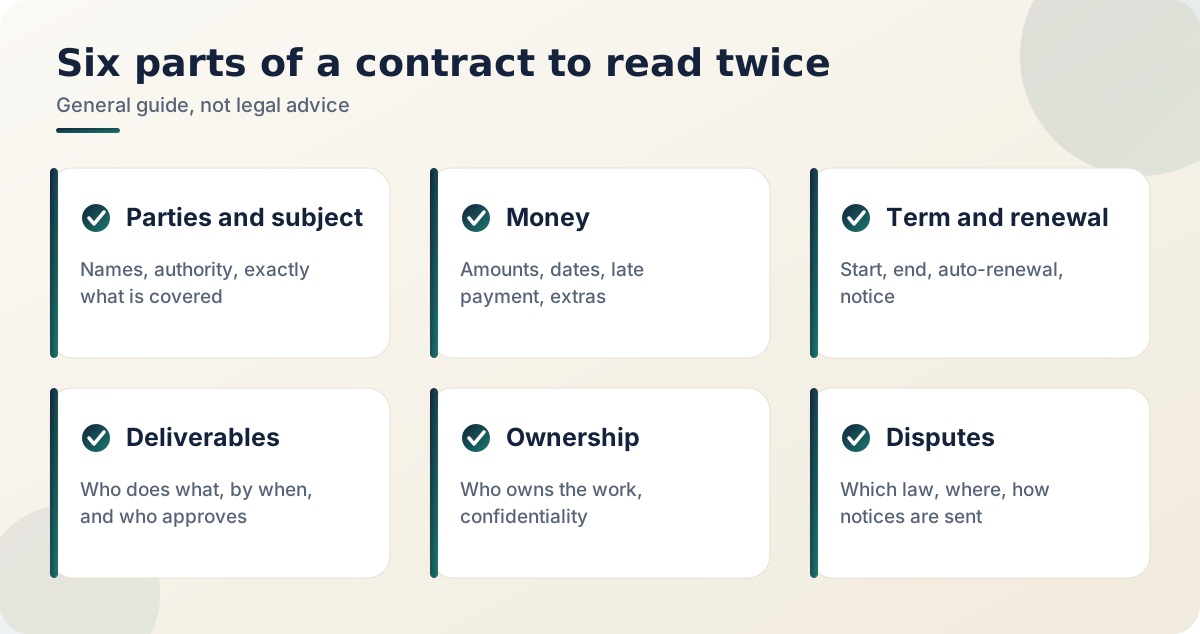
Part 1: Start with who and what
Before any clause, check the basics. A surprising number of problems begin here.
- Are the parties named correctly? Use full legal names, not a nickname or a shop's trading name.
- Does the person signing have the authority? If a company is involved, is it the company or an individual who is signing, and can that person bind it?
- Is the subject clear? Exactly what is being sold, rented, built or provided? Vague descriptions favour whoever has the better memory, or the better lawyer.
- Are the dates written plainly? Start, end, deadlines and renewals.
Part 2: Money deserves a second read
This is where most disputes live.
| Question | Why it matters |
|---|---|
| How much, in which currency, and when is each payment due? | Avoids arguments about the amount and the timing |
| Is there a deposit, and can it be refunded? | Decides who carries the risk if the deal falls through |
| What happens if payment is late? | Interest, penalties and the right to stop work |
| Who pays taxes, fees and extra costs? | Hidden costs are the usual surprise |
| On long contracts, can the price rise? | You need to know how much and with what notice |
If you see phrases like "reasonable fee" or "market rate", ask what that means in actual numbers. A phrase that sounds fair can turn out to mean whatever the stronger side later decides.
Part 3: How it starts, renews and ends
Plenty of contracts renew automatically unless you cancel inside a certain window, and people miss that window and find themselves bound for another year.
- Find the start date and the length.
- Check whether it renews on its own, and how and when you can stop it.
- See whether either side can end it early, on what notice and for which reasons.
- Ask what happens to money paid in advance if it ends early.
Part 4: Who does what, and who owns the result
A good contract is specific about responsibilities. What does each side deliver, by when, and to what standard? How will the work be checked, and who decides it is "done"? With creative or software work, how many rounds of changes are included? When a freelancer and a client fall out, it is often because "finished" meant different things to each of them.
Two clauses matter far more than people expect. The first is intellectual property: who owns the work after it is made, who owns the tools and materials used to make it, and does the client own it only after full payment? The second is confidentiality: what must be kept secret, for how long, and are there exceptions? If you create things for a living, read these twice. Our Bangla freelance checklist goes deeper on this.
Part 5: The scary-sounding clauses
Liability, indemnity and warranties are written in the most intimidating language, which is exactly why people skip them.
- Limitation of liability caps how much one side can be made to pay if something goes wrong. Check that the cap is fair to both of you.
- Indemnity is a promise to cover the other side's losses in certain situations. Make sure you know which situations.
- Warranties are the promises each side makes about quality, authority or accuracy.
Part 6: When things go wrong
Disputes are rare, but the dispute clause decides how costly one would be. Look for which country's or region's law applies, whether disagreements go to court, arbitration or mediation first, and where. See how formal notices must be sent (in writing, by email, to which address) and what the contract says about events nobody controls, such as natural disasters or government orders.
Small phrases that change a lot
| Phrase | What it can mean |
|---|---|
| Including but not limited to | The list is much wider than what is written |
| Sole discretion | One side can decide without explaining |
| Time is of the essence | Missing a deadline can be a serious breach |
| Entire agreement | Earlier promises and emails no longer count |
If something was promised verbally, make sure it is now in the text.
A routine that works
- Read the whole thing once without stopping, just to understand the deal.
- Read it again with a pen, marking every date, every amount and every "you must".
- List what is missing: things that were discussed but never written down.
- Ask for changes in writing and keep every version.
- Sign only the final version, and keep a full signed copy somewhere safe.
Frequently asked questions
Is a verbal agreement valid?
Often yes in principle, but it is very hard to prove what was agreed. Writing it down protects both sides.
Can I change a contract after signing?
Usually only if both sides agree, and it should be done in writing, signed or confirmed by both.
What if I do not understand a clause?
Ask the other side to explain it in writing, or ask a lawyer. Do not sign something you cannot explain.
Do online terms and conditions count as contracts?
They can. Accepting them is often treated as agreeing to the terms, so important ones are worth reading, especially around payment, cancellation and data.
If you need help with a real agreement, you can send a legal enquiry or read about my legal services.
Related reading
- ফ্রিল্যান্সিং শুরুর আগে ক্লায়েন্টের সাথে যা যা লিখিত নেবেন: a Bangla checklist for freelance agreements
- What every Android app privacy policy must include: another document where the details matter
The point of reading a contract is not to find reasons to distrust the other person. It is to make sure you both remember the deal the same way a year from now, when memories have drifted.